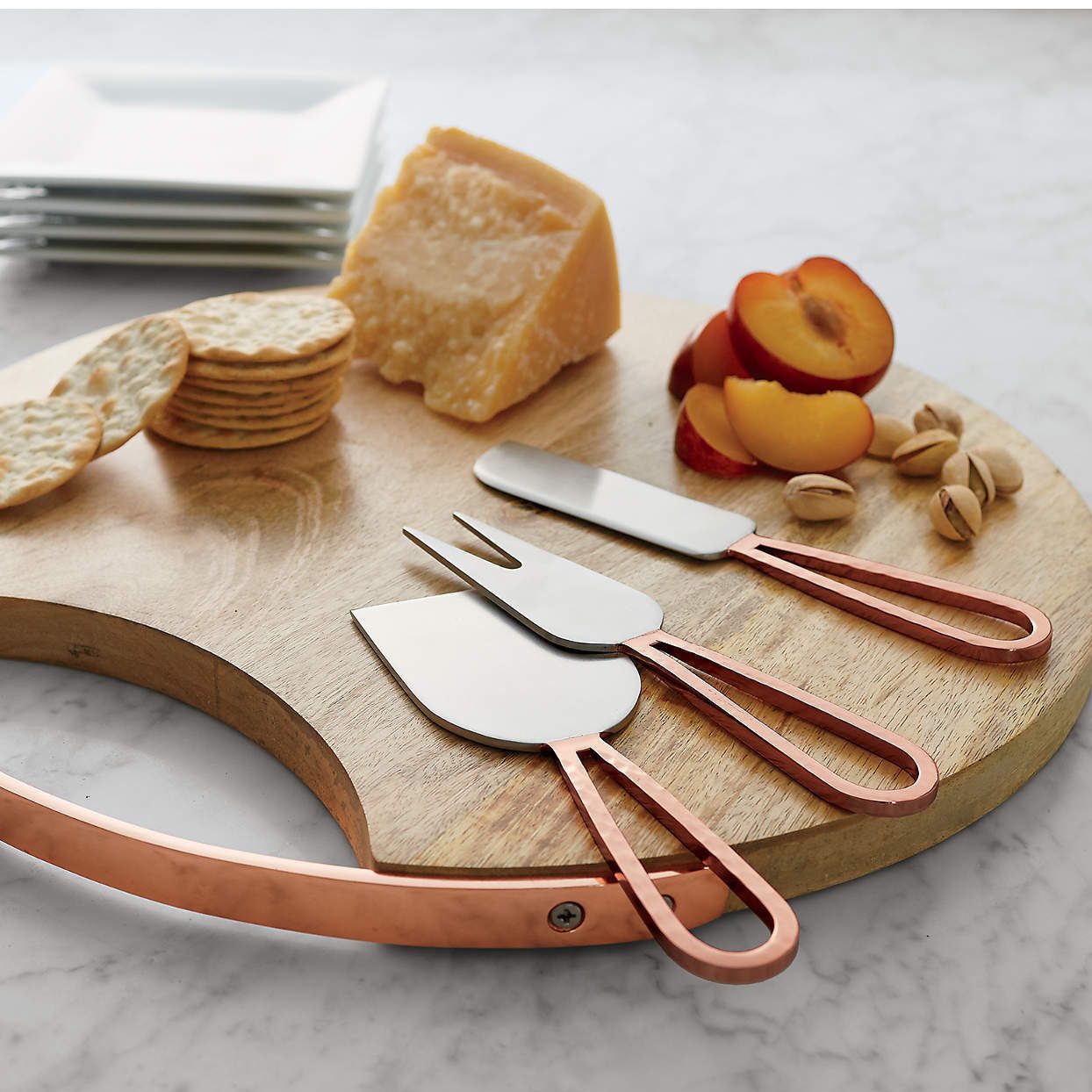
We compiled this guide to cheese knives to explain each knife’s specific capabilities so that you can choose the proper cheese knife for any occasion with confidence.
Our editors and experts handpick every product we feature. We may earn a commission from your purchases.Learn more.

The Soft Cheese Knife
Any guide to cheese knives must include a soft cheese knife. This Wüsthof knife is gourmet-quality and specifically engineered with delicate cheeses in mind. Since soft cheeses are often sticky, the soft cheese knife (sometimes called the open blade knife) is filled with holes to reduce the space for soft and semi-soft cheeses to stick to. Yet, its blade is sharp for slicing into gooey cheeses with bloomy rinds, like Brie, Camembert or chevre. It works beautifully for our almond and brandy brie recipe.

The Spade Knife
This spade knife from Sanelli is designed with professional quality for home cooks. Although most closely associated with parmesan (often called the parmesan knife), the spade knife works well for hard cheeses. The spade knife has a pointed edge for picking off bites of dry, aged cheeses and breaking into firm rinds—perfect for Parmesan or pecorino. Learn about the difference between Parmesan and Parmigiano Reggiano.

The Pronged Knife
This pronged knife from Sur la Table features a stylish knot design. The pronged knife is a must-have, multi-purpose cheese knife for your set. Its sharp blade and narrow size are designed for a variety of cheeses ranging from semi-soft to hard. Since the pronged edge is used to pick cheese up and plate it, this cheese knife is a great choice for your next cheese board. Get creative with your selection and try Muenster, Morbier or one of these unique cheeses.

The Cheese Wire
One of the more sophisticated pieces in this guide to cheese knives is this cheese wire. Otherwise known as a harp wire, this tool features a comfortable handle and fine wire for slicing a variety of cheeses. Add one to your kitchen to make clean slices of semi-soft to semi-hard cheeses. Simply place your cheese on a cutting board and slice downward in vertical movements. It makes beautiful rounds from fresh mozzarella. With a little basil and a few tomatoes, you’ll be all set to make our classic Caprese salad.

The Slim Blade Knife
Boska, a Dutch knife-maker, casts this slim-blade knife in one piece. Its ultra-fine blade is best suited for soft or semi-soft, sticky cheeses, such as Brie or Halloumi, because it provides scarce surface-area for the cheeses to stick to. Its offset handle allows for comfortable gripping and slicing by widening the gap between the user’s knuckles and the surface they are cutting on. Whether serving from a platter or preparing goat cheese and fig crostini, you’ll be glad you have the right knife for creamy cheeses.

The Hard Cheese Knife
This hard-cheese knife comes with double, offset handles, which allows the user to slice through a wheel of cheese completely without running their knuckles into the cutting board. Other hard-cheese knives often feature a single handle or a pronged tip. However, all hard-cheese knives have an offset handle and a durable blade designed to break the firmest rinds. It is ideal for all firm-cheese wheels and wedges—such as fontina, Asiago and Jarlsberg. We suggest you head straight to the best cheese shop in your state and start stocking up!

The Spreader
Our guide to cheese knives would be incomplete without mention of the cheese spreader, also known as the spatula knife. This Laguiole speader is of the utmost quality, but also provides a splash of color to your cheese-knife set. Its curved blade is dull, making it ineffective for cutting slices but perfect for spreading soft cheeses like ricotta, cream cheese and other cheesy spreads and dips.

The Cheese Plane
The top-notch, Rösle cheese-plane brings out the flavor of hard cheeses with its narrow gap and serrated blade. Similar to the flat-edge knife, the cheese plane is shaped like a paddle. However, it’s dull around its edges and features a slit that carves paper-thin slices of cheese. It is ideal for semi-soft to semi-hard cheeses—like Swiss. To use, simply hold the cheese wedge in one hand and use your other hand to drag the upward-facing plane toward you.